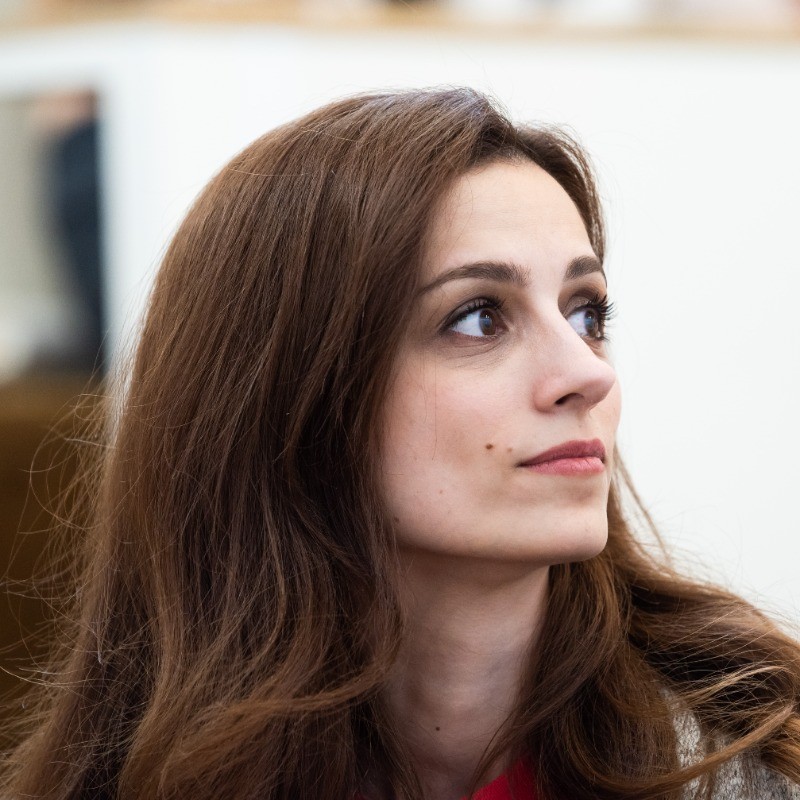

Author: Elif Shafak
Genre: Literary fiction, historical, contemporary novel
Pages: 368
Publication date: 2006
The Bastard of Istanbul is a novel written by Elif Shafak in 2006. Because of this book, she had to go through court proceedings, since she is a Turkish writer who openly wrote about the Armenian genocide of 1915. This topic is largely banned in Turkey, and people who raise the issue or recognize the Armenian genocide have often faced pressure or prosecution by the Turkish authorities.
In the novel, Shafak tells two parallel stories centered around two families: the Turkish Kazanchis and the Armenian Chachmakhchians. What I found especially interesting is that even the surnames carry meaning. Kazanchi and Chachmakhchian are both common surnames found among Armenians and Turks. In my opinion, Shafak chose these surnames intentionally, especially to show how deep our roots can go and how closely connected they remain, even when history tries to separate them.
As an Armenian, I was genuinely glad to read this story written by a Turkish author. What I appreciated most was that the book was not a confession of Turkish people massacring 1.5 million Armenians. Its focus is on accepting history and understanding how deeply intertwined our roots are.
Shafak shows how history has mixed identities over generations—how Turks may marry people with Armenian ancestry, or how Armenians might not even know that their grandparents were once Armenian. The message, as I understood it, is that only through acknowledgment and acceptance can we break the generational curse carried by families on both sides and finally begin to live in peace.
Introducing the Two Family Stories — Without Spoilers
Like I mentioned, the book tells two stories in parallel, which later begin to intertwine. Let’s get to know the characters of each family of Kazanchi and Chachmakhchian
The Kazanchies
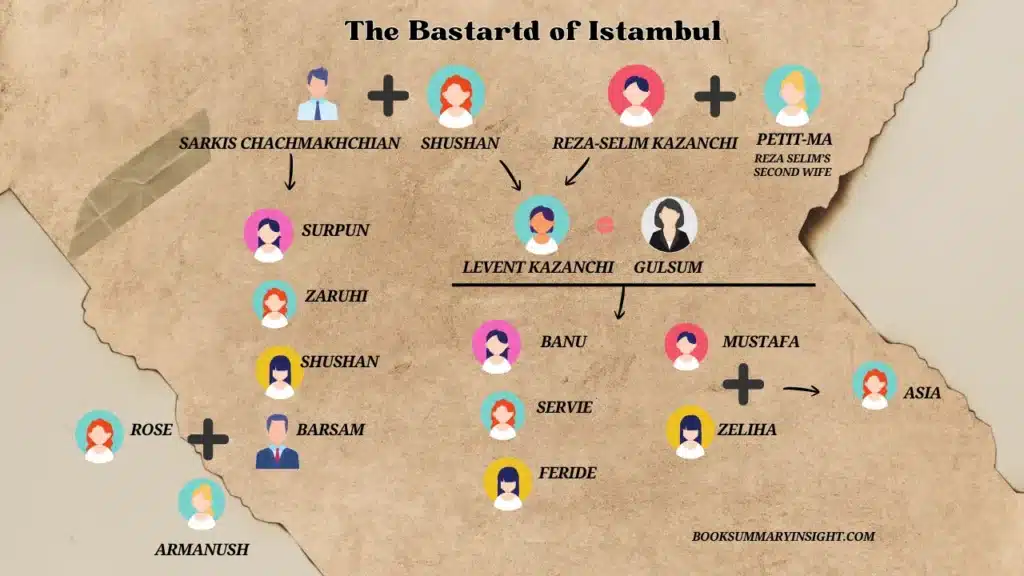
Like I mentioned, the book tells two stories in parallel, which later begin to intertwine. The first story is about the Kazanci family and starts with Petit-ma. Petit-ma was very young when she moved to Turkey with her mother from Greece. There, she met her future husband, Reza Selim—a man whose wife had abandoned him and who was thirty-five years older than Petit-ma.
Petitma chose to marry Reza Selim. He already had a son from his first marriage named Levent. At first, Petitma and Reza Selim didn’t have children because Petitma was very young, and later they couldn’t have children because her husband was already quite old.
Levent grew up to be a cruel and very angry person, deeply affected by being abandoned by his mother. He never accepted Petitma as his real mother. Later, Levent married Gülşüm but died young, at the age of 51. Together, they had four daughters and one son. At the beginning of the novel, we are introduced to each of these children, and we gradually learn the story of every character in the family.
- Zeliha was a nineteen-year-old rebellious teenager who was already pregnant and decided to keep the child. That child later becomes one of the central figures of the book—Asya, the “bastard of Istanbul.”
- Sevriye, another sister, was in love with Celal, but their story ended tragically. Celal was imprisoned after a fight, and just one day before his release, he was electrocuted by a faulty cable and died.
- Banu had once been married but never truly lived with her husband. She became pregnant with twins, but both children died before they even learned how to sleep.
- And then there was Feride—a woman with many oddities, withdrawn into herself, strange in her own way, and difficult to fully understand.
- Mustafa is another important figure in the story. He is Zeliha’s brother and Asya’s uncle, a quiet and withdrawn man who carries a heavy, unspoken guilt.
The Chachmakhchian
The second storyline follows the Armenian Chakhmakhchian family, who live in the United States. At the center of this family is Shushan, the strong-willed matriarch who survived the Armenian Genocide and carried that trauma with her for the rest of her life. She raised her children with a deep sense of loss, memory, and anger toward Turks, determined never to let the past be forgotten.
Her son Barsam married an American woman named Rose. Rose is a complex character—confused, searching, and often overwhelmed by the weight of the history she married into. Together they have a daughter and name her Armanoush.
Later Rose divorces and ends up marrying a Turkish man named Mustafa.
The Bastard of Istanbul Summary with Spoilers
Spoilers ahead, because from this point on, the story becomes fully intertwined between the two families.
Here is the deal. Armanoush decides to come to Turkey to learn about the ancestors of her grandmother, who escaped the country after the genocide. Armanoush’s family was destroyed during the 1915 massacres. Her father was taken on April 24, 1915. He was a writer and one of the more than 200 Armenian intellectuals who were rounded up in Istanbul that night and later executed.
She finds her mother’s second husband’s family, which turns out to be the Kazancı family. When Armanoush arrives in Turkey, she tries to find her grandmother’s old house, but she fails. Soon, we realize that Levent Kazancı was, in fact, Armenian.
After the genocide, Armanoush’s grandmother, Shushan, was taken to an orphanage, where she was given a Turkish name. This was very common at that time. Armenian orphans were sent to orphanages in Lebanon, Syria, Turkey, and other places, where they were systematically Turkified.
Reza Selim takes Shushan as his wife, and together they have a son. Shushan initially wants to name him Levon, which is an Armenian name, but since the child is being raised in Turkey, his name is changed to Levent. Later, Shushan’s brothers find her in Turkey, and she makes the painful decision to leave her husband and son behind and escape to the United States.
In the U.S., Shushan starts a new family. Her son Barsam later has a daughter and names her Armanoush. Meanwhile, on the Turkish side, Levent never knows that he is Armenian. He marries Gülşüm, and they have five children—four daughters and one son. That son, Mustafa, later marries Armanoush’s mother.
If this feels too complicated, below I’ll introduce you to the family tree of The Bastard of Istanbul.
Why I liked the book
At the beginning, when Elif Shafak started introducing the Turkish and Armenian families, I had no idea the story would lead to the Armenian Genocide. That realization came as a surprise. When it did, I became very skeptical about how she, as a Turkish writer, would portray an Armenian family. But this novel explores Armenian–Turkish history, identity, and inherited trauma through two interconnected families.
But as the story unfolded, that skepticism slowly disappeared. The traditions, the food, the everyday habits—even the small cultural details of Armenian life—were presented in a very careful and respectful way. The similarities between Armenian and Turkish culture were shown naturally, without forcing a point, and without denying history.
What stood out to me most was her choice of names and family background. She clearly based the Armenian family on Western Armenian traditions. This matters, because many Armenians living in Armenia today no longer carry those traditional names. Western Armenians, who are largely descendants of genocide survivors, preserved them. That detail felt intentional and deeply researched.
Most importantly, there was no judgment in the book. No accusation, no defensiveness, no hidden agenda.
On the contrary, the author was trying to show how many similarities exist between these two nations—and there really are many. Historically, Armenians and Turks lived on the same land for centuries, and over time their cultures became deeply intertwined. Even today, you can see it in small things, like food, traditions, and especially hospitality, which is very strong in both cultures.
What I also found very accurate was how Shafak portrayed the different ways each side carries history. Armenians grow up hearing about the genocide constantly, and they carry that grief inside them. This is very true. At the same time, the Turkish side is often either unaware of what happened or taught to see the Armenian Genocide as merely an outcome of war. This, too, felt realistic and honest.
A little bit of a criticism
The story flows so smoothly and reads so lightly that you really want a resolution. But the characters never learn the truth about how deeply connected they are. I understand why Shafak chose this approach: the future of the Armenian–Turkish conflict itself is still uncertain. It may take a very long time to resolve, or it may never fully resolve at all. In that sense, the ending reflects reality—but as a reader, I still wished for more closure.
The only thing I didn’t like was that Shushan left her son. I feel that an Armenian mother wouldn’t normally do this. But I’m no one to judge, and there were probably reasons strong enough to force such a decision. And if Shushan hadn’t left her son, Levent, this entire story wouldn’t have happened. So in a way, she had to do it for this book to exist at all.
What does the book teach us
And again, like in many of Shafak’s other books—especially The Forty Rules of Love, where she speaks about religion and how it can unite instead of divide—we see the same motive here. The message is that history needs to be accepted. Grief has to be acknowledged and released, because carrying the pain of something that happened more than a century ago continues to affect generations.
That grief, that memory of loss, needs to be faced so that our ancestors can finally rest in peace. Only then can the curse that started back then leave us. Otherwise, it keeps repeating itself—like the Kazancı family constantly losing its male members. To me, this feels like a symbolic curse born from unaccepted history.
By accepting the past, not denying it or hiding from it, we allow healing to begin. Only then can future generations be open to new beginnings, better lives, and a future not shaped entirely by inherited pain.
Key themes in The Bastard of Istanbul: Armenian Genocide and historical memory, Identity and cultural erasure, Inherited trauma and silence,Family secrets and intergenerational pain, Acceptance versus denial, Reconciliation and healing