

Somewhere, right now, Big Brother is watching you. You know it. You have learned to live with it – and that, Orwell would say, is exactly the problem. The system has a face, a logic so airtight that even love becomes a crime, even thought becomes treason. 1984 is not a dystopian fantasy. It is a warning. And the most terrifying thing about it is not that Orwell imagined it. It is that we keep living it, and we keep being surprised.
George Orwell wrote this book as a warning, and the terrifying thing is that with every passing year, it feels less like fiction and more like a mirror. The ministries of Truth, of Love, of Peace — built not to serve their names but to destroy them. A world where history is rewritten daily, where language is shrunk so that rebellion becomes literally unthinkable, where a man can be erased so completely that he never existed at all. I read this book and I could not shake it. And I suspect, if you are here, neither could you.”
This article about books like 1984 is not a ranked list. It is a personal map — the books that I actually read, the ones that surprised me, challenged me, and in some cases, changed me. Some of them are obvious neighbours of 1984. Others share only its DNA, its underlying obsession with power, control, and what happens to a human being when a system decides to own them. All of them are worth your time.
Table of Contents
Animal Farm — George Orwell

Animal Farm was the first dystopian book I ever read. I picked it up before I even touched 1984, which is perhaps the right order — even if Orwell wrote it second. I had no idea what was coming. The author opens with animals on a farm, their relationship with their farmer, a world that seems almost innocent. I didn’t fully understand what was unfolding at first. But the fuss around this book was so enormous that I kept reading. And I was right to.
It wasn’t in vain. This book became one of my all-time favourites because Orwell, in the simplest possible way, explains the entire mechanics of revolution — how it happens, why it fails, and why human beings refuse to learn from history. The names change. The slogans change. The pigs who take power look different from the farmer they replaced. But in reality, everything stays the same. The boot is still on the same face. It just belongs to someone new.
If you have never read a dystopian novel, start here.
Things in common with 1984: Revolution that replaces one tyrant with another, propaganda, rewriting of history, language used as a tool of control.
Themes: Power and corruption, revolution, political allegory, the cyclical nature of history.
Why I liked it: Orwell explains the entire mechanics of revolution in the simplest, most elegant way possible — and makes you realise that the names change but the system never does.
Best for: Anyone new to dystopian fiction; readers who want a short, powerful entry point that hits harder than its size suggests
Who should skip: Nobody. This one is for everyone.
Brave New World — Aldous Huxley

I want to be honest with you: among all the books on this list, Brave New World is my absolute favourite. It is, in my opinion, the most underappreciated dystopian novel ever written. People talk about 1984. They teach 1984. But Huxley’s masterpiece sits in its shadow, quietly, patiently — and it is the more unsettling of the two.
Here is my sincere advice: do not read this book in your teens or your twenties. You will not appreciate it. Read it in your thirties, when you have lived enough to understand what is actually being taken from the people in its pages.
The novel opens with a tour of a facility where human beings are manufactured on an assembly line — literally grown, conditioned, pre-determined before they are even born. The social hierarchy is built into the biology. The people are happy. That is the horror of it. This is not a society controlled by fear, like in 1984. It is a society controlled by pleasure, by distraction, by the complete elimination of the desire to want anything different. Huxley asks a question that Orwell never quite gets to: what if they don’t need the boot? What if they can make you love your cage?
This book is not long. It will grip you from the first few pages. The quotes alone will stay with you for years.
Things in common with 1984: Total state control over human beings, elimination of individual thought, forbidden relationships, a society built on fear disguised as happiness.
Themes: Manufactured happiness, loss of identity, consumerism, biotechnology, free will.
Why I liked it: It asks a question Orwell never gets to — what if the cage is so comfortable that nobody wants to leave? That question stayed with me for a long time.
Best for: Readers in their thirties and beyond who have lived enough to feel what is truly being taken from the people in its pages.
Who should skip: Younger readers — not because it is inappropriate, but because you genuinely will not appreciate it yet. Come back to it later.
We — Yevgeny Zamyatin

Before there was 1984, there was We. Zamyatin wrote it in 1920, and Orwell almost certainly read it. The parallels are impossible to miss: the surveillance state, the thought police, the ministries with Orwellian names, the forbidden love that threatens to crack the system open — it is all here, decades before Orwell put it on the page.
The protagonist is a mathematician living in a totalitarian state called OneState. He cannot think outside the boundaries the system has drawn for him. He is afraid, always, that he is being watched. And then — just like Winston and Julia in 1984, just like Adam and Eve in the oldest story we have — something tempts him beyond the walls. The ending is not entirely unlike Orwell’s. Bleak, but earned.
If you have already read 1984, be prepared: We will feel familiar. Almost like a repetition. But that is because it is the original. Zamyatin did not imitate Orwell. Orwell learned from Zamyatin.
Things in common with 1984: Surveillance state, thought control, forbidden love, a protagonist trying to break free from a totalitarian system, a bleak ending.
Themes: Individuality vs. conformity, surveillance, rebellion, the Adam and Eve archetype.
Why I liked it: Knowing that Orwell drew directly from this book makes every page fascinating. It is like reading the blueprint of 1984.
Best for: Readers who loved 1984 and want to go deeper into where it came from.
Who should skip: Readers who want something completely different from 1984 — this one is so similar it may feel like a repetition if read back to back
Fahrenheit 451 — Ray Bradbury
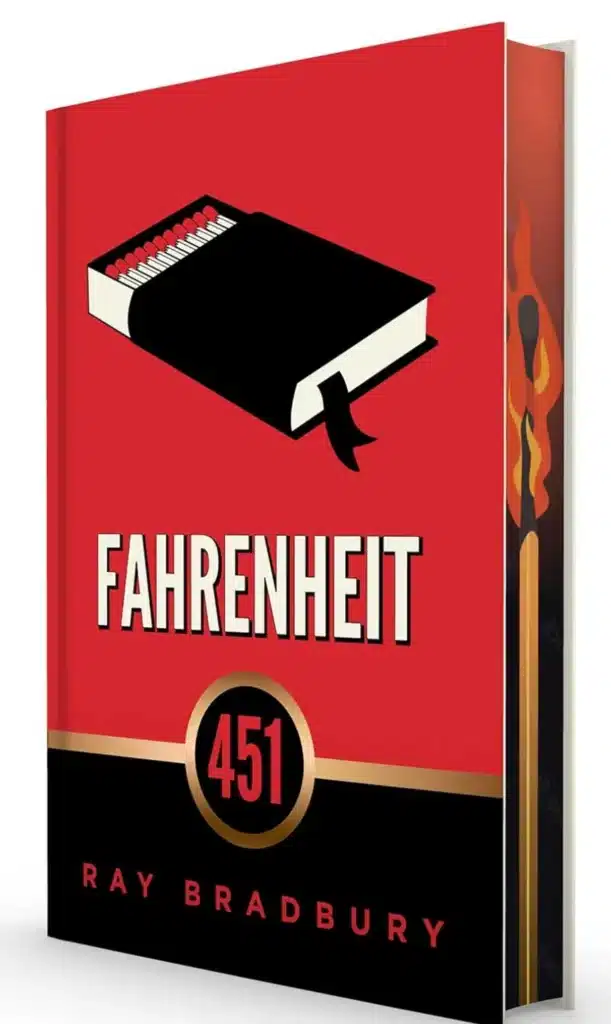
I read Fahrenheit 451 before 1984, during the year its Armenian translation was published. People were talking about it everywhere. That kind of cultural moment around a book is rare, and it is usually a signal worth following.
The premise is precise and terrifying: books are illegal. Firemen don’t put out fires — they start them. The enemy is not a dictator giving speeches. It is comfort. It is the slow, voluntary surrender of the difficult, the challenging, the books that make you think. The society in Bradbury’s novel did not ban books through force alone. People simply stopped wanting them.
I have to be honest about the ending: it is open, and I personally don’t love open endings. I prefer closure. But I will tell you this — if you are the kind of reader who can appreciate a journey for its own sake, the road to that ending is extraordinary. The journey is worth it. Enjoy the ride.
Things in common with 1984: A society where information is controlled and suppressed, fear of independent thought, a system that punishes those who question it.
Themes: Censorship, intellectual freedom, conformity, the danger of comfort.
Why I liked it: The premise is razor sharp — firemen who start fires instead of putting them out. And the idea that people voluntarily stopped wanting books is more frightening than any government ban.
Best for: Readers who enjoy a fast, atmospheric read with a strong central idea.
Who should skip: Readers who need a satisfying, closed ending — the open ending will frustrate you.
A Clockwork Orange — Anthony Burgess

This is the most brutal book on this list. I want to say that clearly, upfront, as a warning and as a recommendation in the same breath.
The story follows a young criminal who is caught by the state and subjected to a programme of psychological conditioning designed to make him docile, harmless, acceptable. It is not a political book in the way that 1984 is political. But it shares the same DNA — the state reaching inside a human being and rearranging what it finds there. The crime is not what he did. The crime is what he is. And the system wants to fix that.
I am sensitive to violent content, and I will admit I skipped certain scenes. Some of the descriptions are genuinely difficult. But the philosophy underneath all of it — the questions Burgess is asking about free will, about what it means to be human, about whether a person who cannot choose evil can truly choose good — those questions are extraordinary. I liked many of the quotes deeply. I recommend this book to friends. Just go in prepared.
Things in common with 1984: State control over the inner world, psychological conditioning, the erasure of individual identity, the question of whether a human being can be owned by a system Themes: Free will, state violence, morality, rehabilitation, what it means to be human
Why I liked it: The philosophical questions underneath the brutality are extraordinary — can a person who cannot choose evil truly choose good? That stayed with me.
Best for: Readers who can handle dark, violent content and are drawn to deep philosophical questions about freedom and human nature.
Who should skip: Sensitive readers — the violence is graphic and unflinching. If brutal scenes affect you deeply, approach with caution or skip it entirely
The Autumn of the Patriarch — Gabriel García Márquez

This was one of the hardest books I have ever read in my life. I included it in another article I wrote about the most difficult books of all time, and it belongs there. García Márquez writes entire sentences that are a page long. There are no chapters. There are barely any paragraphs. The text is a torrent, a flood, something you have to swim through rather than walk.
But if you swallow the book — if you push through to the end — it is worth every difficult page.
Márquez was what I can only describe as a kind of “good crazy.” He has this magical ability to describe things at a level that is simultaneously simple and profound. The book is about a patriarch who seems to never die. Generations pass. People whisper about him. They fear him and love him. They invent stories about him. Nobody is sure what is real anymore. The dictator becomes mythology before he becomes history.
This is not a fast read. This is not a comfortable read. But García Márquez is one of my favourite writers, and this novel proves why. Some books demand something from you. Give this one what it asks.
Things in common with 1984: A dictator whose power seems absolute and eternal, a population living in fear and myth, the blurring of truth and propaganda.
Themes: Dictatorship, myth, power, solitude, the relationship between a people and their tyrant.
Why I liked it: Márquez is a kind of good crazy — his ability to make something simultaneously simple and profound is unlike anyone else. The dictator becoming mythology before he becomes history is unforgettable.
Best for: Patient, experienced readers who are ready to work for their reward and appreciate literary ambition over plot.
Who should skip: Readers who need structure, chapters, and clear narrative flow — the style is relentless and will exhaust you if you are not ready for it
Faust — Johann Wolfgang von Goethe

I want to be transparent: Faust sits a little outside the pure dystopian tradition. Thematically, it is not as close to 1984 as the others on this list. But it shares the DNA — the underlying obsession with power, with the corruption of an honest person, with what happens when ambition outgrows conscience.
Goethe’s story is ancient and modern at the same time. God and the Devil make a wager over the soul of Faust, an honest and brilliant man. The Devil visits him, befriends him, and slowly the transformation begins. What Goethe is capturing is the spirit of an era — the political currents, the philosophical tensions, the world in the process of being built and rebuilt. It speaks to the same fears that run through all the books on this list: what is a man worth when power decides to test him?
My practical advice: read Faust with Wikipedia open beside you. I did exactly this, and I am not ashamed of it. There is a great deal of historical and philosophical context that Goethe assumes his reader knows. Once you have that context, the book opens up completely. You will finish it smarter than you started it.
Things in common with 1984: The corruption of an honest person by power, the soul as something that can be bargained away, the political and philosophical forces that shape human destiny.
Themes: Ambition, temptation, the human soul, the price of knowledge, good vs evil.
Why I liked it: It is one of the great masterpieces of world literature, and once you have the historical context, it opens up completely. You finish it smarter than you started.
Best for: Readers who enjoy classics and are willing to do a little research alongside their reading — keep Wikipedia open.
Who should skip: Readers looking for a fast, plot-driven book — Faust demands patience and context
Player Piano — Kurt Vonnegut

Player Piano was Vonnegut’s first novel, published in 1952, and it reads like a warning that arrived a little too early to be taken seriously. The machines have taken over — not through violence, not through conquest, but through efficiency. The economy has been automated. The engineers and managers who run the machines form a new elite class. Everyone else is superfluous. They are fed, housed, cared for — and utterly without purpose.
The protagonist, Paul Proteus, is one of the elite. He has everything the system says he should want: status, salary, a respected position. And yet something is wrong. He begins to feel the hollowness at the centre of a world where human beings are no longer necessary for anything that matters. The revolution he eventually stumbles toward is not led by the oppressed — it is led by a man who had everything and found it meaningless.
Vonnegut does not write with the grim, airless intensity of Orwell. He writes with something darker in some ways: irony. The jokes land. The satire cuts. And underneath the wit is a question that has only become more urgent with time — what does a human being do when the economy no longer needs them?
Things in common with 1984: A rigidly stratified society, the individual crushed by a system that has decided his role, the hollowness of a life lived inside someone else’s design
Themes: Automation, purpose, class, the meaning of work, the cost of progress
Why I liked it: Vonnegut does what Orwell doesn’t — he makes you laugh. And then the joke lands, and you realise it wasn’t funny at all.
Best for: Readers who enjoy satire and dark irony, and anyone thinking about what automation and AI are doing to human purpose right now — this book feels more relevant every year.
Who should skip: Readers who want the grim intensity of Orwell — Vonnegut’s tone is lighter, and if you need that weight you may find this one too ironic
A Final Word
These eight books are not eight separate arguments. They are one long conversation, conducted across more than a century, in multiple languages, from multiple corners of the world. Zamyatin whispered something to Orwell. Orwell shouted it to Huxley. Huxley answered it differently. Bradbury translated it into fire. Burgess put it inside a boy’s skull. Vonnegut made it into a joke that isn’t funny. Márquez turned it into mythology. Goethe found it in a wager between God and the Devil.
The question underneath all of them is the same: what does power do to human beings? And what do human beings do — what can they do — when the system has decided to own them?
Read these books. Not all at once. Let them breathe. Come back to them. The conversation they are having is still going on.