
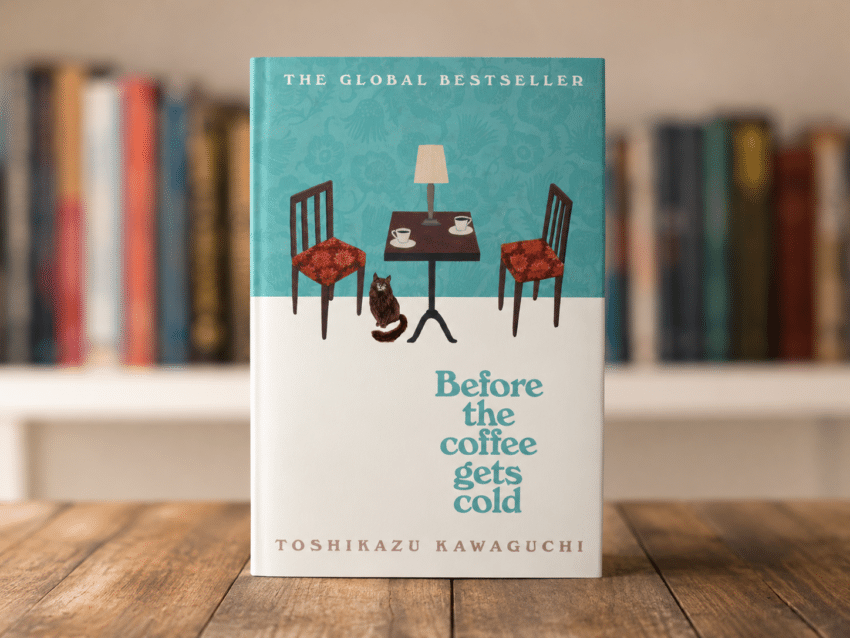
Author: Toshikazu Kawaguchi
Genres: Magical Realism, Contemporary Fiction
Originally Published: December 2015
Number of pages: 213
Table of Contents
This was my first time reading a Japanese writer. It happened almost by accident. I was heading into a vacation and wanted something light, something meaningful, something about life, the kind of book I could read on trains and in airports without it weighing me down. I actually walked into a bookstore and asked for something like The Midnight Library. That’s the comparison I gave the bookseller. She listened, thought for a second, and handed me Before the Coffee Gets Cold by Toshikazu Kawaguchi instead.
And from the first pages, I could tell why she picked it. It opens light. Almost deceptively light. I remember thinking, okay, this is going to be an easy, gentle read for the trip, and in a lot of ways, it was. But it also sat with me longer than I expected it to.
For context on just how far this small, quiet book has traveled, it’s sold more than five million copies worldwide and been translated into fourteen languages. The full series has six parts, only four of which are currently available here in Armenia, and the first one is by far the most well known, so that’s the one I’m covering in this article.
Synopsis
All four stories in this book take place in the same tiny, hard to find café in Tokyo, and each one follows someone who’s carrying a regret they never got to fix. If you’re just here to decide whether the book is worth reading, I’ll say this much: it is, especially if you want something light that still leaves a mark. If you want the full picture, chapter by chapter, keep reading below.
Full Summary with Ending Explained
The Café and Its Rules
The book is built around a small, old-fashioned café, the kind of place that feels almost disconnected from time itself. It’s on the ground floor with no windows, kept cool and dim, and you genuinely can’t tell what time of day it is inside. That detail isn’t just atmosphere, it’s the whole point. This café lets people travel through time.
But the rules are strict, and they’re what make the book interesting rather than gimmicky:
- You can only travel back to a moment when you were physically in the café.
- You can only meet people who also came to the café.
- Nothing you do in the past can change the present. Nothing. If someone left, if someone died, that still happens, no matter what you say or do.
- You have to sit in one specific seat, occupied by a mysterious woman in white, and you can only travel once she gets up (usually for the bathroom).
- You cannot touch her or try to move her. Legend says she’ll curse you if you do.
- Once you travel back, you’re poured a cup of coffee, and you have to return before it gets cold. Not a second later.
Because of these rules, especially the one about not being able to change anything, the café isn’t exactly crowded. Most people, understandably, only want to go back in time to fix something. If that’s off the table, what’s the point? That question ends up being the quiet engine behind every story in the book.
Story One: Fumiko and Goro
The book opens with Fumiko, who heard the café’s legend and came hoping to go back to the last time she saw her boyfriend, Goro. She’d expected him to propose that day. Instead, he told her he’d gotten the job he’d always wanted, in the US, and that he’d need to leave for at least two years. Heartbroken, and now determined to go back and tell him how she really felt, she waits for the woman in white to get up, drinks her coffee before it goes cold, and returns to that moment. She almost tells him everything. Instead, he’s the one who suggests waiting the two years to see where things go. She comes back to the present with nothing changed on paper, but with a flicker of hope she didn’t have before.
Story Two: Kohtake and Fusagi
This one is quieter and heavier. Fusagi, Kohtake’s husband, has Alzheimer’s, and the story opens with him already disoriented, holding a letter, barely remembering his own past, or her. Kohtake learns from Kazu, one of the café workers, that Fusagi had once come here with a letter meant for her, but never gave it to her. Determined to find out what it said, Kohtake makes the trip back. She meets her husband before the disease took hold, and they have an honest, painful conversation. He already knows what’s coming, and tells her she doesn’t have to devote her life to caring for him once he no longer remembers who she is. She goes back anyway. He hands her the letter in which he asked her to just remember him as her husband, not become his nurse, and told her that if his illness ever became too much to bear, she should feel free to leave him. He didn’t want her staying out of duty or pity — he wanted her to stay because she chose to, as his wife.
Story Three: Hirai and Kumi
Two sisters. Kumi runs the family inn in Sendai after Hirai left home to run her own bar in Tokyo. Kumi comes to the café hoping to talk to her sister, and Hirai is actually there the whole time, hidden with help from the café staff, listening but not showing herself. Kumi leaves without knowing her sister heard everything, writes her a note, and the next day dies in a car accident. Hirai is devastated. In the note, Kumi had been asking her to reconcile with their parents, who never forgave Hirai for walking away from the family business, and to come home. Hirai travels back, meets her sister one last time, and promises her she’ll make peace with their parents and take over the inn together with her. She keeps that promise once she’s back in the present.
Story Four: Kei and Nagare
The final story ties everything together. Kei, married to café owner Nagare, has a heart condition and discovers she’s pregnant. Her doctor warns that labor could be extremely dangerous for her. Earlier in the book, during the sisters’ chapter, a young girl visits the café, sits in the time travel seat, takes a photo with Kei, and leaves, and we didn’t know who she was. In this final chapter, we find out: she’s Kei’s own daughter, visiting from the future. Instead of going back in time, Kei chooses to go forward, to see what’s become of her child. She finds her husband and Kazu, the café’s waitress, raising the little girl with love, alongside the rest of the café’s staff, who’ve become like an extended family to her. Because of how the timeline shifts, she arrives further into the future than planned and doesn’t get to see her husband clearly or know exactly when she’s arrived, but she does get to see her daughter, and that she’s happy. She returns to the present, goes into labor, and faces it knowing that whatever happens to her, her daughter will be okay.
Characters in Before the Coffee Gets Cold
- Fumiko Kiyokawa — a career-driven medical IT director, and the lead of the first story. She comes to the café hoping to reconnect with Goro before he leaves for America.
- Goro Katada — Fumiko’s boyfriend, an aspiring game programmer whose dream job pulls him to the US.
- Kohtake — a hospital nurse and café regular, married to Fusagi.
- Fusagi — Kohtake’s husband, a former landscape gardener living with early-onset Alzheimer’s.
- Yaeko Hirai — runs a late-night bar near the café, estranged from her family after leaving home to build her own life in Tokyo.
- Kumi Hirai — Hirai’s younger sister, who stayed behind to manage the family inn in Sendai.
- Kei Tokita — co-owner of the café alongside her husband Nagare, living with a heart condition that makes her pregnancy dangerous.
- Nagare Tokita — the café’s owner and chef, Kei’s husband.
- Kazu Tokita — the young waitress who pours the coffee and guides every visitor through the time travel ritual.
- The Woman in White (the ghost) — the mysterious, near-silent woman who occupies the time travel seat and must leave it voluntarily before anyone else can sit down.
- Miki — Kei and Nagare’s daughter, seen earlier in the book only as “the girl” who visits the café from the future.
A Few Things Worth Knowing About the Book
- Before the Coffee Gets Cold started out as a stage play. Kawaguchi wrote and directed it himself, and it won the 2013 Suginami Drama Festival grand prize before he turned it into a novel.
- It was adapted into a Japanese film in 2018, called Café Funiculi Funicula, named after the café itself.
- A TV series adaptation has also been reported in development.
- It’s part of a larger series: Before the Coffee Gets Cold, Tales from the Café, Before Your Memory Fades, Before We Say Goodbye, Before We Forget Kindness, and a sixth book, Before I Knew I Loved You.
- The English translation, by Geoffrey Trousselot, came out in 2019, four years after the original Japanese release in 2015.
Before the Coffee Gets Cold Review
If you’re expecting the book to sit you down and explain what each character learned from their trip to the past, that’s not going to happen. Kawaguchi doesn’t do that. He leaves it entirely up to you to connect the dots, and honestly, that’s the biggest difference between this and something like The Midnight Library, or any of Matt Haig’s other time-travel work. Haig tends to walk you toward the meaning. Kawaguchi just hands you the scene and steps back.
At first, that felt like a flaw. In Fusagi and Kohtake’s story, for example, if you’re just skimming the surface, you might think: nothing happened, they just talked. But that’s exactly the point. The story is quietly teaching you that the moment to say what you feel doesn’t wait for you. Fumiko missed her chance to tell Goro how she felt, and lost the opportunity for him to be the one to suggest waiting together.
The second story carries the same idea forward, just with more weight behind it. If Kohtake and Fusagi had spoken honestly earlier, before the Alzheimer’s took hold, the road they walked together afterward might have been a little lighter, a little less heavy on both of them. Saying what you feel doesn’t erase hardship, but it does make it easier to carry.
The sisters’ story hits the same note from another angle: face the problem while you still can. Talk. Make peace. Life doesn’t wait for the right moment, it can end without warning.
And the final story is really about unconditional love, about figuring out what you value most, even at real cost to yourself. Kei chooses her daughter’s future over the certainty of her own. Would she have made that same choice without knowing her daughter turns out okay? I don’t think anyone, including the book, can answer that. But it’s a magical, quietly devastating way to close things out, and it’s the part that stayed with me the longest.
Overall, I rate Before the Coffee Gets Cold a 7 out of 10. It’s not a book that changes how you think about time travel or fiction as a whole, and if you go in expecting deep, spelled-out lessons, you might come away thinking nothing happened. But if you let the quiet moments do their work, it earns its reputation. My one real complaint is the same one a lot of readers share: the rules get repeated a few too many times across the four stories. You’ll know them by heart before you’re halfway through.
As for outside ratings, Before the Coffee Gets Cold sits at 3.65 out of 5 on Goodreads, based on more than 700,000 ratings, which tells you it’s a divisive book. Readers either fall for its quiet, repetitive style or find it too simple. I landed somewhere in the middle, closer to the side that fell for it.
Who I’d Recommend This To
If you want something light to read before bed, or something to keep you company on a long flight or train ride, like I was, this is a great fit. It’s gentle on the surface, but if you let it, it’ll ask you something quieter underneath: what would you actually go back to say, if you could?
Frequently Asked Questions
Is Before the Coffee Gets Cold a real time travel book, or magical realism?
It’s usually shelved as magical realism rather than science fiction. There’s no scientific explanation for the time travel here, it works more like a quiet, almost spiritual rule of the café than a mechanism.
Who is the woman in white in the café?
She’s the “ghost,” a woman who once let her own coffee go cold while visiting the past and became trapped in the time travel seat as a result. She barely speaks, and only gives up the seat when she goes to the bathroom.
Who is the mysterious girl who takes a photo with Kei?
She’s revealed in the final story to be Kei’s own daughter, Miki, visiting from the future.
Does Kei survive childbirth?
The book doesn’t show us directly. It ends before we find out, with Kei going into labor reassured that whatever happens to her, her daughter will be safe and loved.
Is Before the Coffee Gets Cold based on a play?
Yes. Kawaguchi originally wrote it as a stage play, which won the 2013 Suginami Drama Festival prize before he turned it into a novel.
Is there a movie or show based on the book?
Yes, a Japanese film called Café Funiculi Funicula came out in 2018, and a TV adaptation has also been reported in development.
How many books are in the Before the Coffee Gets Cold series?
There are six so far: Before the Coffee Gets Cold, Tales from the Café, Before Your Memory Fades, Before We Say Goodbye, Before We Forget Kindness, and Before I Knew I Loved You.
Is Before the Coffee Gets Cold appropriate for teens?
There’s nothing explicit in it. The themes, grief, illness, regret, are handled gently, so it’s generally considered suitable for teen readers, though some of the emotional weight, especially Fusagi’s Alzheimer’s and Kei’s risk during childbirth, may hit harder for younger readers.
What is the main lesson of Before the Coffee Gets Cold?
The book never spells it out directly, but the four stories all circle the same idea: you can’t change the past, but talking honestly and being present with the people you love changes how you carry it forward.