
Before I even pick up a book, I do a little research to find out what kind of read might suit my current state of mind. If I’m feeling calm but a little overwhelmed with work, I’ll go for something light — a romance by Marc Levy, perhaps, or a detective story by Agatha Christie. But when I’m craving something emotional, something that nurtures my soul, or when I want to dive deeper and really analyse and learn — that’s when I reach for something heavier, like Dante Alighieri’s “The Divine Comedy” or Dostoyevsky’s “The Idiot” or “The Brothers Karamazov.”
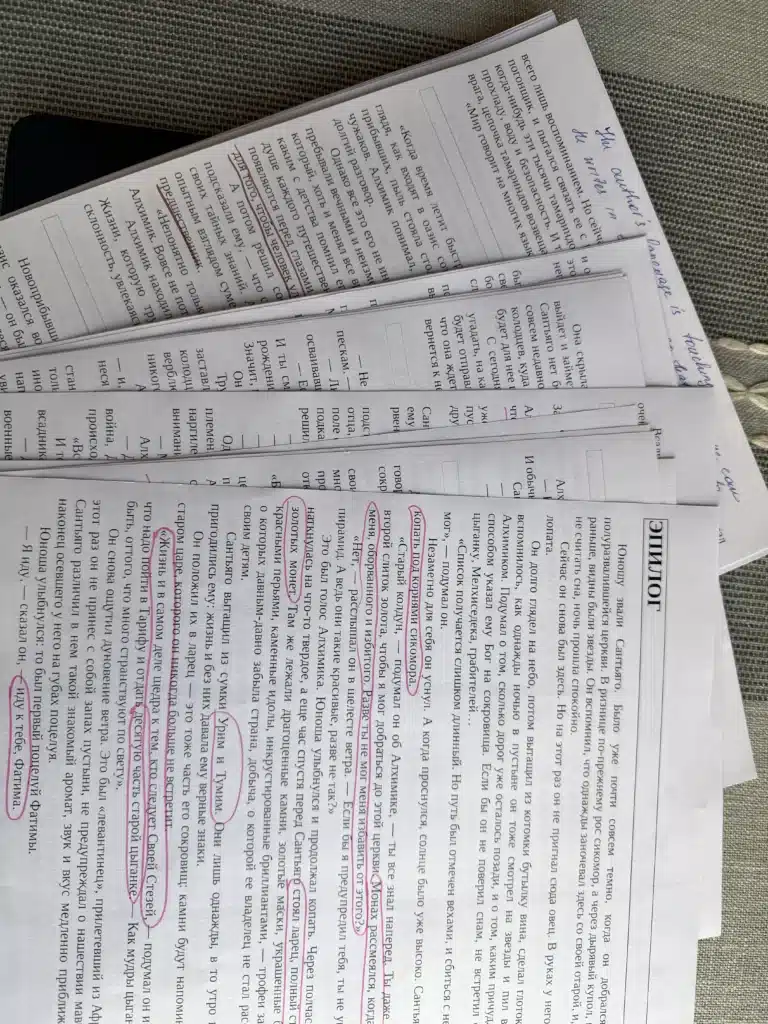


Once I’ve chosen a book, I make sure I have a copy — or I order one. Since books can be quite expensive here, I often read in Russian instead of Armenian, as the prices are nearly double. If I can’t find it in Russian or I’m eager to start right away, I’ll simply print the book and begin reading.
As you’ll see in the screenshots I’m attaching, I take detailed notes throughout. I jot down quotes I love, key points, character descriptions, and more. I also write down questions I’d like to ask the author myself, and I analyze as I go. After finishing, I often Google things the author mentions that I’m unfamiliar with — so I can grasp the full story. For instance, when I read “Pygmalion” by Bernard Shaw, I didn’t understand why he chose that title, so I had to research and dig through forums to see what others thought and which interpretation was correct.
Essentially, I do a comprehensive analysis of each book — to truly understand it, to absorb it, to digest it. This thorough approach allows me to give you an honest review and an honest summary.
Here’s a breakdown of how I personally rate each book and what I take into consideration when assigning scores. This helps keep reviews honest, consistent, and transparent for the reader.
What I Consider When Rating
My ratings aren’t just gut reactions — I evaluate each book based on several key aspects:
1. Writing Style
Is the prose elegant, clear, and engaging? Does the author have a distinctive voice or use language creatively?
2. Plot and Structure
Is the storyline well-constructed and coherent? Are there plot holes, or does the pacing feel off?
3. Themes and Depth
Does the book tackle meaningful questions or ideas? Is there philosophical, emotional, or intellectual weight behind the narrative?
4. Character Development
Are the characters layered and believable? Do they grow over time, or remain flat and stereotypical?
5. Emotional Impact
Did the book make me feel something — joy, sorrow, awe, discomfort? A great book lingers in your mind.
6. Originality
Does the book offer a fresh perspective or unique voice? Or does it feel like a rehash of tropes we’ve seen too often?
The Review Scale (1 to 10)
| Score | Meaning |
|---|---|
| 10 | Masterpiece. Deeply moving, thought-provoking, unforgettable. A book I will revisit. |
| 9 | Excellent. Nearly flawless, compelling, and powerful. Just a hair away from perfect. |
| 8 | Very good. Strong and enjoyable with only minor issues. Highly recommended. |
| 7 | Solid. Worth reading, though not particularly groundbreaking or moving. |
| 6 | Decent. Some good moments, but uneven or lacking in key areas. |
| 5 | Average. Fine, but forgettable. Didn’t leave much of a mark. |
| 4 | Below average. Disappointing, with several flaws that hurt the experience. |
| 3 | Weak. Struggled to finish. Poor execution despite a possibly good idea. |
| 2 | Bad. Nearly unreadable or fundamentally broken. |
| 1 | Terrible. No redeeming qualities. Likely abandoned halfway through. |
I don’t rate books lightly. Even when I criticize, it comes from a place of respect for the craft. My goal is to help you discover books that are not only worth reading — but worth remembering.
📚 Happy reading,