
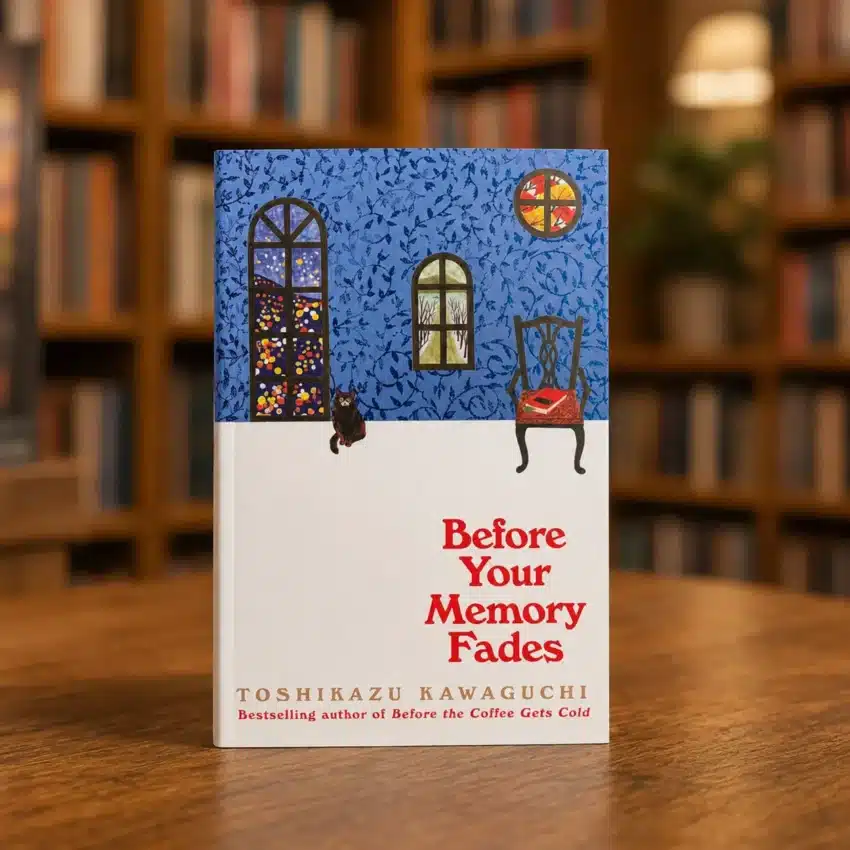
Author: Toshikazu Kawaguchi
Genres: Japanese contemporary fiction, magical realism, grief and loss
Originally Published: September 1, 2018
Number of pages: 220
Series: 3rd book of the series
A New Café, A Familiar Magic
Before Your Memory Fades moves the action to Café Donna Donna, a sister café in Hakodate owned by Yukari Tokita – the mother of Nagare, who runs the original Funiculi Funicula café in Tokyo. Yukari has left, somewhat suddenly, for America – we later learn it’s for two reasons: she’s searching for the father of one of the café’s young customers, and separately, searching for a bone-marrow donor for someone dear to the story.
In her absence, Nagare manages the café alongside his cousin Kazu, and Kazu’s curious seven-year-old daughter, Sachi – currently the only person able to pour the time-traveling coffee at this location. Rounding out the café’s world are Reiji Ono, a part-time employee chasing a career in comedy, and regulars Nanako Matsubara (Reiji’s childhood friend) and Dr. Saki Muraoka, a local psychiatrist.
The rules of the café remain exactly as devoted readers know them: you can only meet someone who has visited the café themselves; only one seat allows time travel, and it’s normally occupied by a ghostly figure who vacates it just once a day; and the rule that trips up nearly every visitor emotionally – nothing you do in the past can change the present.
This book is entirely dedicated to people processing loss – each of the four stories centers on a visitor trying to find peace with someone who has already died.
Story 1: Yayoi – Confronting the Parents She Lost
Yayoi Seto arrives at the café in visible despair, at one point muttering that she’d be better off dead. She returns a second time, and Kazu notices she’s holding an old family photograph – herself as a baby, held by her parents, alongside a young Yukari.
Yayoi’s parents died in a car accident when she was an infant. She was shuffled between relatives who eventually found her too much to manage, growing up with her cruel siblings in a house that never felt like home. She left as soon as she could, worked hard, but never shook the belief that her parents had abandoned her by dying – and she carries deep resentment toward them.
She decides to travel to the past – not to save them, but to confront them. She’s devastated to learn the café’s central, “ridiculous” rule: nothing she does can change the present. Still, she takes the seat and travels back roughly two decades, to a café run by a much younger Yukari.
There, she watches her parents — happy, together, cradling baby Yayoi. She overhears her mother, Miyuki, thanking Yukari, her husband: Miyuki reveals she too was orphaned young, shuffled among relatives, denied a proper education, bullied and once stood at the edge of ending her own life, until Yukari intervened. Despite carrying the same wounds Yayoi carries now, Miyuki chose happiness instead of giving up.
Yayoi never tells her parents who she really is. When she’s asked to photograph the family, she looks through the viewfinder and sees the truth she’s carried for twenty years without understanding it: she was never unwanted – she was a baby held close, at the center of her parents’ joy. She drinks the coffee and returns.
Immediately after, the ghost in the chair transforms into a gaunt, grieving young woman. It’s Miyuki herself, arriving from a time before Yayoi’s birth, at the exact point she nearly gave up on her life. Yukari the café owner had placed her there with only vague instructions: picture the future you want. Kazu tells her that the woman she’s about to meet is her own daughter. Yayoi, letting go of all her resentment, tells her mother she’s twenty now, living happily, engaged to be married. Miyuki holds her daughter’s face, promises to keep fighting, and fades away, calling her name beautiful.
Mother and daughter, without either fully realizing it in the moment, saved each other across time.
Story 2: Todoroki – Telling His Wife They Finally Won
Comedy duo PORON DORON – made up of Kohta Hayashida and Gen Todoroki has just won the prestigious Comedian’s Grand Prix, a goal they chased for years. But immediately afterward, Todoroki vanishes.
Hayashida comes to the café searching for his partner, and staff explain that Todoroki’s late wife, Setsuko, had always dreamed of visiting this very café – they suspect he’ll eventually come to see her. Days later, he does, determined to travel to the past to see her, and just as determined to stay there rather than return.
When Todoroki reaches Setsuko his wife, she senses immediately that something significant has happened in his future. Learning that they’ve finally won the award she always believed he could win, she reacts with pure joy. Sensing his despair, she refuses to let him give up: she tells him his life isn’t over, and that the only way he can keep making her happy is by living fully and continuing to chase new goals. She convinces him to drink the coffee and return – and he does, reuniting with a relieved Hayashida in the present, the two of them ready to keep building their careers together.
Story 3: Reiko – A Sister’s Last Wish
Reiko Nunokawa arrives at the café accompanied by Dr. Saki Muraoka, in a severe psychological state: depression, burnout, and difficulty distinguishing dream from reality. Her younger sister, Yukika, who had once worked at this very café, died a few months earlier after a long illness.
During a thunderstorm-driven power outage, Yukika appears in the time-travel chair. She reveals she already knew she was dying, and that she has one message for her sister: she wants Reiko to keep smiling – because what frightens Yukika most isn’t death itself, but the thought of her sister losing her happiness because of her. Reiko promises, sealing it with the pinky-promise ritual the sisters shared growing up, just before the lights return and Yukika disappears.
A postcard later reveals that Yukari had quietly arranged this exact meeting months in advance, before she left for America.
Story 4: Reiji and Nanako – A Love Confessed Too Late
Reiji Ono, the café’s comedy-obsessed employee, has been chasing his dream of a professional audition. Throughout the story, Nanako – his lifelong childhood friend – is close by, gently teasing him about his humor. At one pivotal moment, Nanako tries to tell him something important, but the moment slips away just as Reiji learns he’s finally landed his big break: a spot that means moving to Tokyo.
After he leaves, we learn the truth: Reiji and Nanako had quietly loved each other for years, both too afraid to say so. When Reiji later returns briefly for his belongings, he learns Nanako has been living with a rare blood disease for years and has traveled to America for a bone-marrow transplant – the donor found through Yukari’s own search.
Torn between his dream and his fear of losing her, Reiji uses the café’s chair to travel back one week, to the last time he saw her before her surgery. Sensing she’s terrified beneath her forced calm, he doesn’t offer comfort – he blurts out an impulsive proposal, telling her that in the future, she insists they get married. It gives her something to hold onto going into surgery. He returns to the present determined to succeed, for her sake.
A postcard arrives showing Nanako recovering well after surgery. But months later, news reaches Nagare: her body has rejected the donor marrow. Despite a second surgery, she doesn’t survive.
Years later, on his fifth attempt, Reiji finally wins the very Comedian’s Grand Prix that Setsuko once dreamed of for Todoroki. He visits Nanako’s grave overlooking Hakodate Bay, carrying a book Sachi once gave him – and tucks a wedding ring into its final page.
The Book’s Closing Message
The book ends on the passage that gives the novel its emotional core — one I won’t quote directly here out of respect for the author’s original text, but which conveys, in essence: that one person’s death should never become the reason for another person’s lasting unhappiness, because no one is born simply to suffer. Everyone is born with the capacity — and the purpose — to become happy.
That’s the throughline across all four stories: people learning that grief, however real and however deserved, shouldn’t be allowed to override the life still ahead of them. If our loved ones could see us broken and stuck in misery on their account, it wouldn’t bring them peace — it would only add to what was already lost. The title itself suggests something gentle: that the people we’ve lost stay with us for as long as we carry their memory forward.
My Honest Review
The message here is clear, and it’s a genuinely important one. Grief follows recognizable phases – loss, depression, burnout – and almost everyone who has lost someone shares the same aching wish: one more conversation, one more chance at closure, one more word of encouragement from the person who’s gone. Many of us also carry guilt simply for being happy while our loved ones no longer can be. This book speaks directly to that.
That said, structurally, the four stories in this book feel very similar to one another, and I don’t think the payoff in each is developed with enough depth. A younger reader – a teenager or someone in their twenties without much lived experience of loss – might come away seeing this as a light, comforting story rather than something that truly sits with them. The premise itself traveling to the past or future to reconcile with someone you’ve lost is an enormous, weighty idea. It deserves an equally weighty resolution each time, and across the three books I’ve now read in this series, I consistently feel like the emotional payoff is a little too gentle, a little too neat, for the size of the questions being raised.
I also have to be honest: I wish Nanako had lived. Every single one of the four stories in this book ends in loss or death in some form. After that much heaviness, I think the book needed at least one moment of pure, unclouded relief something to reassure the reader alongside the characters, rather than asking us to find comfort entirely within grief itself.
Still, it’s a quick, accessible read, and if you’ve enjoyed the earlier books in the series. I’m planning to read the fourth book in the series next.
Overall, I’m giving this one a 6/10.
If you need summary of the first two series, here they are:
Before the coffee gets cold
Tales from the café
This book – and this article – touch on grief, depression, and suicidal thoughts. If you’re struggling with any of this yourself, please consider reaching out to a mental health professional or a crisis line in your area.