
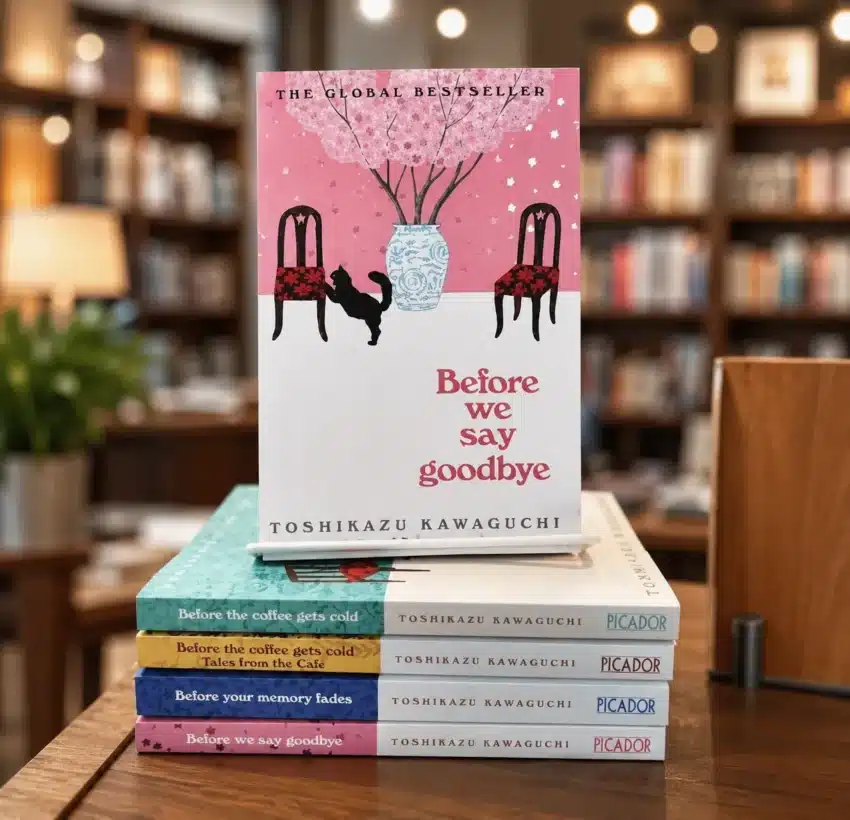
Author: Toshikazu Kawaguchi
Genres: Japanese contemporary fiction, magical realism, grief and loss
Originally Published: September 20, 2021
Number of pages: 188
Series: 4rd book of the series
If you have already read the first three books, I have to be honest with you: this one is getting a bit boring. If you have not read any of them yet, you could actually pick this one up first, because it is basically identical in structure to the other three.
Of the four books I have read so far, the first one is still the most interesting to me, simply because I was not familiar with the concept yet. The rest repeat a lot of the same ground, but I think that is intentional. All six books in the series follow the same concept: four separate stories, the same rules, different visitors. I think it is built this way on purpose, so you can pick up any single book, even without knowing it is part of a series, and still follow along: people who want to go back to the past, or forward to the future, to fix something they never got to fix.
Story 1: The Husband, Monji Kadokura and Mieko
The first chapter is called “The Husband,” and it is about Monji Kadokura. His wife is in a vegetative state, and he is a retired archaeologist and adventurer, deeply curious about the café itself. He asks a lot of questions, like what exactly the rules of traveling to the past are, but the rules stay the same as in the other books. You can only visit someone who has visited the café themselves. You cannot change the present. You have to drink the coffee before it gets cold, or you become a ghost yourself. Once you travel to the past, you cannot leave the chair you are sitting in, and you have to wait for the woman currently occupying it, the ghost, who is Kazu’s mother, to get up. She only leaves the chair once a day, to go to the bathroom.
After asking all the questions he was curious about, like whether people remember what they were told once they return, Kazu and Nagare answer that yes, they remember, but it is up to them whether they choose to believe it or not. Kadokura wants to go back and see his wife, Mieko, who has now been in a vegetative state for a long stretch of time. Even knowing he cannot change the present, he wants to try to do something that might help.
When he sits in the chair and Kazu pours the coffee, he turns to steam and everything spins around him, and he arrives in the past to find his wife and their three children. They are angry, believing their father is away on an expedition, but he has appeared instead. The children accuse him of being selfish, of never thinking of their mother, especially since he completely forgot their wedding anniversary.
He tells them he does not have much time, and he warns Mieko that something bad is going to happen to her, that she will fall into a coma. He hopes that even a small detail like that warning might somehow soften or delay what is coming. The story also reveals that he was never really present as a father or husband, almost never home, and yet Mieko always waited for him anyway. Even so, during their conversation, she tells him she always valued him. He returns to the present, where his wife is still in her coma. But the very last pages of the book reveal that, after all this time, she wakes up.
Story 2: The Farewell, Mutsuo, Sunao, and Their Dog Apollo
The second story is about a couple who lost their dog. It begins with Mutsuo coming to the café, wanting to bring his wife, who is devastated over losing their dog, Apollo. Kazu and Nagare tell him it is best if she does not find out about the café this way, that she needs to discover it and the idea of time travel on her own.
After Mutsuo leaves, his wife, Sunao, eventually comes to the café on her own. She had heard about it from an old magazine years earlier, and claims she came to return an umbrella she had borrowed from someone. In reality, she blames herself for falling asleep the night Apollo died, for not being there to help him, even though she knows rationally that he was already old and unwell.
After Kazu explains the rules, she travels back. The story reveals that the couple was never able to have children, despite trying everything, including IVF, and that Apollo had become something like a child to them, they even called themselves mommy and daddy. In the past, she reunites with her husband and Apollo, who is overjoyed to see her. She understands that Apollo has already died in her present, and confesses her guilt over falling asleep that night. Her husband reassures her that Apollo always used to wait for her to fall asleep first, before settling down himself, so it is likely he simply did the same thing, and passed peacefully in his sleep rather than alone or afraid. She lets go of the guilt and returns to the present.
Story 3: The Proposal, Hikari and Yoji
The third story is called “The Proposal.” Hikari comes to the café and tells her story to Fumiko, the woman we first met in the very first book of the series. Hikari’s boyfriend, Yoji, had once proposed to her, and she turned him down. He told her he would always wait for her. Some time later, he told her he had met someone else, and shortly after that, he died.
Hikari has come to the café because she blames herself. Over time, she came to realize he truly understood her and supported her, but in the moment of the proposal, she hesitated, unsure if it was the right decision. She travels back to see him. Yoji immediately realizes she has come from the future and tells her he had actually brought her to this very café back then on purpose, suspecting that if she refused him, she might one day want to come back and talk to him.
He also reveals he was sick, and had chosen not to tell her, not wanting her to marry him out of pity. He says he is almost certainly gone by the time she is speaking to him from. He tells her he knows how much she truly loved him, and proposes again. This time, she accepts the ring. She returns to the present having finally told him how she really felt, and she does not regret it, even knowing none of it could change what actually happened.
Story 4: The Daughter, Michiko and Kengo
The fourth story is called “The Daughter,” and it is about Michiko and her father, Kengo. Michiko grew up with her father after her mother died, and always felt like he was controlling everything, her lessons, her bedtime, her friendships, constantly telling her what to do and not do. He also worked constantly. Their relationship deteriorated, and she eventually moved to Tokyo to study, putting real distance between them.
After about a year of silence, her father came to visit her, bringing gifts from her favorite sweet shop. She rejected him outright and said things she would later deeply regret. Not long after that visit, the 2011 earthquake happened, and her father did not survive it, he had gone back home at the last moment to retrieve a bankbook, money he had been saving for her wedding.
Michiko comes to the café to go back and speak to him again. She travels not to the day of the earthquake itself, but to revisit an earlier moment between them, noticing how tired and aged he looked by then. Their conversation is brief. He apologizes for showing up and disturbing her, saying he only wanted to know she was alright. She tells him she is pregnant, that she has a boyfriend, and, even though she admits she did not value him enough for most of her life, she tells him she is genuinely happy he was her father. He is happy to hear it. When she returns to the present, she feels relieved, holding onto the memory of his happy face.
The Closing Scene
The book ends with Kazu and Nagare talking. We learn that Kadokura’s wife has woken from her coma. Nagare, meanwhile, is raising his one year old daughter, Miki, on his own, her mother, Kei, a character we first met in the very first book of the series, died giving birth to her a year earlier.
One more thing worth knowing before you dive in: this book is actually set chronologically between the first and second books in the series, not after them. Even though it published fourth, the story itself takes place earlier in the timeline than Tales from the Café.
My Honest Review
Like I already said at the beginning, this is very much the same book as the ones before it. The stories are different, but the structure, the rules, the rhythm, all of it stays the same. The café itself does not evolve. You never see a new rule introduced, you never see anyone push against the boundaries, nothing surprising or unexpected happens within the mechanics of the place itself. No one forgets to drink the coffee. Nothing spicy happens, so to speak.
By this point, this being the fourth book, I wanted more. I wanted to know why Kazu’s mother became a ghost in the first place. I wanted to know if Nagare ever wants to go back and visit his wife in the past, or if Kazu carries her own regrets, because we never really get access to Kazu’s emotions. She stays composed and almost emotionless throughout, understandably, given what happened to her mother, but I want more of her story specifically.
The stories themselves have started to feel very similar to one another across these books. In almost every single one, someone has died, it cannot be undone, and the visitor goes back only to work through their own regret, from their own perspective. Nothing about the actual outcome changes. People pass away, but at least the visitor makes peace with themselves and returns to the future able to move forward. That message really is important. But by the time you are on the fourth book built on the exact same structure, I will admit, some of that impact starts to wear thin for me.
I am rating this one 6 out of 10, mostly because of that repetition. If I had picked this up as a standalone book, without having read the first three, I think I still would have gotten the message, and I think I still would have been curious enough to go looking for Kazu’s story, to learn there is a first book that tells it. Maybe Kazu’s mother’s full story is waiting in the fifth or sixth book, which I am planning to read next, and I will absolutely share those with you too, since I have committed to reading this entire series and telling you about all six.
Have you read Before We Say Goodbye, or the rest of the Before the Coffee Gets Cold series?