
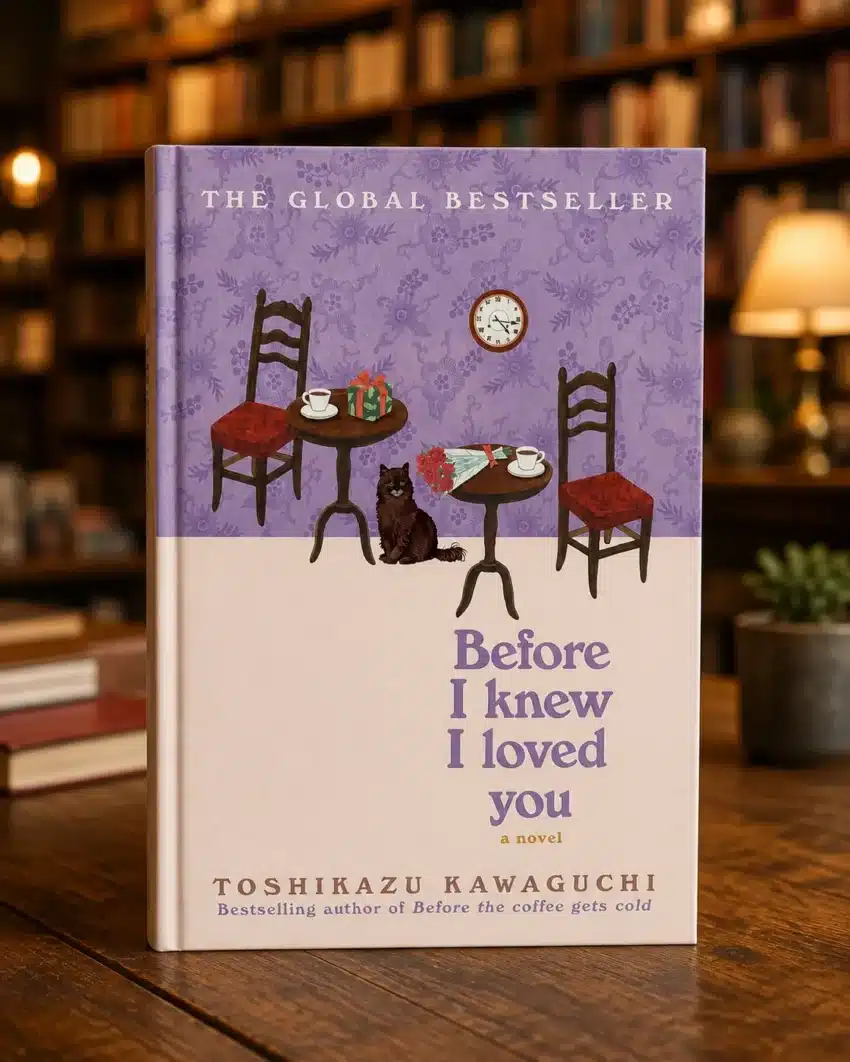
Author: Toshikazu Kawaguchi
Genres: Japanese contemporary fiction, magical realism, grief and loss
Originally Published: September 24, 2024
Number of pages: 240
Series: 6th book of the series
This is the last translated book, at least for now, of Toshikazu Kawaguchi’s Before the Coffee Gets Cold series, and yes, I read all five of the others too. And I have to tell you honestly: this one is no different from any of the other five.
Here’s the thing that surprised me most across this whole series. At first, you’d think you have to read these books in order. But the truth is, the storylines of the main recurring characters, the café’s waitresses and owners, repeat enough background in every single book that you could genuinely walk into a bookstore with no idea these six books are even connected, pick just one off the shelf, and still fully understand and enjoy it on its own.
Below are all four storylines from this book. After that, my honest review.
Story 1: The Runaway
Azami Togo’s biological mother, Miyuki, died of ALS when Azami was still in elementary school. About a year later, her father remarried a woman named Yumiko, Miyuki’s own childhood friend. Azami never accepted her, feeling as though Yumiko had stolen the role of caring for the household that Azami had taken on herself after her mother’s death. At fourteen, Azami ran away from home, and was found days later wandering a shopping arcade in Kagoshima by an exhausted Yumiko, who had been searching for her for three days straight. Azami shoved her to the ground, screamed that Yumiko wasn’t her real mother, and ran off again.
Even after being found and brought home, Azami refused to speak to Yumiko for years, communicating only through notes when absolutely necessary, and telling a teacher outright, “I don’t think of her as my mother.” She left home permanently as soon as she could, and the estrangement never healed, not even after Azami herself grew up, married, and became a stepmother to her own husband’s child from an earlier relationship, an experience that made her finally understand what she’d put Yumiko through. About two months before visiting the café, she received a call from her father: Yumiko had died. At the funeral, her father told her something that shook her, that Yumiko had never wanted to have more children of her own, specifically so that Azami would always remain her only daughter. Her old bedroom, Azami discovered, had been kept completely untouched all those years, her father explaining that Yumiko had refused to let him pack it away, insisting Azami might come home one day.
At the café, Azami learns from Fumiko (the woman from Book 1 who once traveled back to see her partner Goro) that the rules make a face-to-face reunion impossible, since Yumiko never visited the café herself. But Fumiko, prompted by watching café owner Nagare’s young daughter Miki play with a toy phone, realizes there’s a workaround: Azami can travel to the past and use the café’s actual telephone to call home. Azami travels back to a point when Yumiko is still alive, guided by Nagare’s late wife Kei (appearing here since this scene takes place years before Kei’s death), who hands Azami the phone without asking a single question. Azami very nearly loses her nerve entirely, gripped by fear that her father’s story about Yumiko never wanting more children might have been a lie meant to spare her feelings, and that the real Yumiko might still resent her. She dials anyway. When Yumiko answers, Azami finally calls her “Mum” for the first time in her life, a single word that makes Yumiko break down sobbing on the other end, calling it the happiest moment because it was the first time Azami had ever said it. Azami apologizes for years of silence and cruelty; Yumiko tells her it’s all right, that she doesn’t need to apologize. Azami has to end the call abruptly as the coffee nears its limit, but tells Yumiko, in the last seconds, “Thank you for loving me. I was a terrible daughter, but you kept loving me anyway.”
After Azami returns to the present and leaves the café, the story closes on a quiet exchange between Kazu and Fumiko that’s genuinely new for the series. Fumiko has always wondered, silently, why Kazu’s mother, the ghost occupying the time-travel seat, never came back after going to see her own late husband, given that she herself had been the one who taught Kazu everything about pouring the coffee correctly. Kazu, seemingly reading Fumiko’s thoughts, finally says it herself: that she used to believe her mother chose her father over her, but that lately she’s come to think there isn’t really a hierarchy to how much someone loves you, that her mother never coming back and the love her mother felt for her are simply two separate things. It’s the most direct, personal thing Kazu has ever said about her mother in the entire series, though it’s worth noting clearly: this is Kazu sharing how she’s come to feel about it emotionally, not a revealed explanation for why her mother actually failed to return. That specific mystery is still left open.
Story 2: The Patient Man
In February 2012, junior high student Tomokazu Okishima has a crush on a quiet, reserved classmate named Kanna Ozaki, egged on by a friend, Hayashida, who keeps telling him “Ozaki’s always looking at you.” On Valentine’s Day, Okishima spends the whole day hoping for chocolate from her, terrified of being seen caring too much in front of his friends. Right as school ends, another girl, Misuzu, pulls him into the hallway where a nervous Kanna is waiting with a handmade box of chocolates, a real, romantic confession. But just as Okishima is about to accept it and say thank you, Hayashida blurts out, in front of everyone, that he’d heard Okishima actually likes a different girl, Izumi (something Okishima had said earlier purely to hide his real feelings from Hayashida). Humiliated, both Kanna and Hayashida flee the scene before Okishima can correct the misunderstanding.
The next day, a classmate tells him Kanna was hit by a car on her way home the previous evening. She survives, but sustains a head injury that wipes out her recent memories, including the entire Valentine’s Day incident and, eventually, Okishima himself. Her family transfers her to a school near her father’s hometown to recover, and Okishima never gets the chance to clear things up.
Later that year, Okishima happens to be sitting in Café Funiculi Funicula, the same café Kanna had gone to with a friend right before her accident, and overhears Kazu telling another desperate customer that time travel is, in fact, real. Realizing this is the café Kanna visited, he asks to travel back specifically to the day of the accident, hoping to fix the misunderstanding before it happens. Kazu lays out the full rules for him. When he arrives in the past, he finds himself at a table with Kanna and Misuzu already present, he’d hoped for time to explain everything calmly, but Nagare’s warning about the coffee’s roughly seven-minute window turns out to be accurate almost to the second. Before he can say much, Misuzu blurts out to Kanna that his feelings are mutual, mortifying Kanna, who bolts from the café before he can respond. Nagare offers to run after her and bring her back, but as he’s debating whether there’s still time, Okishima, believing there’s no point since Kanna’s memory loss is coming regardless of what he says, drinks his coffee anyway.
At the very last second, Kanna runs back into the café and shouts that she likes him and wants to date him. With his body already dissolving into steam, Okishima shouts back that he’ll be waiting for her at the café every year on White Day (March 14th, the Japanese holiday when chocolate gifts are reciprocated), for as long as it takes, promising he’ll be there whenever her memory returns, if it ever does.
The story then jumps forward across seven real years, with Okishima visiting the café every single White Day, never knowing if she’ll ever walk through the door. He explains all of this to Fumiko in the present-day frame of the story, who becomes personally invested in the outcome. On the final page of this story, at closing time, years after Okishima started waiting, the café door opens. It isn’t Kazu returning from putting away the sign, it’s Kanna, now grown. She asks him, simply, “Did you wait?” He says no (a quiet, deflecting lie), then hands her a wrapped box: “Happy White Day.” She accepts it with a smile, and the story ends there, deliberately, without spelling out how much she actually remembers.
Story 3: The Secret
Rikako Kabe, a travel agency branch manager obsessed with train timetables since childhood, reconnects with an old high school club senior, Yaeko Hirai, now running a traditional inn in Sendai (Hirai is a returning character from earlier in the series, who once traveled to the past herself to see her late sister). Rikako confides in Yaeko that the man she’s been dating for two years, Gaku Hanada, has proposed, but that she’s just been diagnosed with cancer and given a sixty percent chance of surviving the next five years. She can’t bring herself to say yes without knowing whether she’ll actually be alive to make good on it, and she’s terrified that if Gaku learns she’s sick, he’ll only marry her out of pity. While drinking with Yaeko late into the night, Yaeko lets slip, half drunk, that the café doesn’t just send people to the past, it can send them to the future too, something Yaeko learned from Nagare’s late wife Kei.
Rikako travels to Funiculi Funicula and, rather than admit the real reason for her visit, tells the staff she simply wants to retrieve a train timetable from five years in the future as a kind of souvenir. She’s terrified the entire time, hesitating so badly at one point that Kazu actually suggests she come back another day instead, but Rikako pushes forward anyway. Once in the future, she meets a regular customer and eventually Koku, now revealed to be married to Kazu with a baby daughter, feeding and soothing the child in his arms in the café. Rikako notices that “future Kazu” seems subtly changed, calmer, softer, though not in any way she can fully articulate, and feels a pang of envy watching Koku and Kazu’s quiet domestic happiness. Still too afraid to directly ask whether she’s alive, Rikako instead asks Kazu a proxy question: whether she still buys the monthly train timetable. Kazu answers plainly that the copy Rikako is holding will be her last one. Rikako accepts this instantly, thanks Kazu sincerely for telling her without softening it, and returns to the present.
Believing she now knows she’ll die within five years, Rikako resolves to turn down Gaku’s proposal outright, planning to give him a vague, gentle rejection without explaining why, believing it’s kinder to let him move on and find happiness with someone who won’t leave him a widower. At dinner, though, before she can say anything, Gaku surprises her by producing the ring he’d forgotten to bring the first time he proposed, revealing that a mutual friend, their boss Yajima, had criticized his first proposal as passionless and told him to actually voice his real feelings. Gaku admits his hesitant phrasing the first time around, “I’d like to marry you, if that’s what you want,” came from his own fear of being rejected, not from a lack of real desire to marry her. Realizing Rikako is planning to turn him down, he proposes again, more directly this time, telling her he refuses to give up on marrying her no matter what’s troubling her. Moved, and thinking of Kazu and Koku’s quiet happiness in the future she just witnessed, Rikako finally accepts, deciding she wants whatever time she has left to be spent happily with him, illness and all.
The story then jumps forward to a scene just before Rikako’s actual future visit takes place chronologically, showing Gaku, now Rikako’s husband and father to their baby son, dropping off a train timetable at the café for future-Rikako to “purchase,” along with a private handwritten note tucked inside that he doesn’t expect her to ever read. Fumiko, curious, eventually asks if she can read the note herself, and Gaku agrees. The note reads, addressed to his late wife: that she never gave up until the very end, that she looked happy right up until the end, thanking her, and signing it from her loving husband and son. This confirms, though the book never states it outright, that Rikako did eventually pass away from her illness, but that she and Gaku had the happy years together that she’d hoped for.
Story 4: The Father and Son
Fourteen-year-old Tsuguo Suga was raised solely by his father, Ryutaro, a chef, after his mother abandoned them both shortly after his birth due to postpartum depression, something Ryutaro always quietly blamed himself for rather than her, and never spoke badly of her to his son. Ryutaro died suddenly four months before the story begins, of a heart condition that ran genetically in his family. Tsuguo stumbled across an obscure blog post online describing this café’s ability to send people to the past, and the only lead he has connecting his father to this specific café is a memory of Ryutaro once mentioning, years earlier, that he’d eaten an incredible carbonara somewhere in Jimbocho.
Nagare and regular customer Kinuyo Mita (an art teacher who has quietly hoped for years that Kazu will one day let herself be happy) aren’t certain Ryutaro ever actually visited, but Nagare, thinking of what his own late wife Kei would have said, decides encouraging Tsuguo to just try is worth the risk of disappointment. When Tsuguo travels back, he actually lands on a specific day when his father is in the café’s kitchen, learning to recreate that exact carbonara recipe from Nagare himself, specifically so he can make it for Tsuguo at home. It’s revealed that Ryutaro had tried and failed many times to recreate a carbonara good enough to impress his son, and had humbled himself to ask the café’s owner directly for the recipe, fully expecting to be refused, only for Nagare to simply hand it over.
During their reunion, Tsuguo tells his father that he recently met his birth mother, who asked him to come live with her, information Ryutaro never knew before dying. Tsuguo watches his father’s expression crumple with a mix of shock and quiet heartbreak. Then Tsuguo tells him something that isn’t quite true: that he turned his mother down and plans to stay with his father forever. In reality, this decision, to accept his mother’s offer, only came after Ryutaro had already died; back when Ryutaro was still alive, living with his mother had never actually been something Tsuguo was considering one way or the other. Tsuguo chooses to tell his father this gentle untruth specifically because he can’t bear to let his father die (again, emotionally, in this moment) believing his son might leave him for the mother who abandoned them both. Ryutaro breaks down crying with relief and happiness at hearing it. As Tsuguo drinks the last of his coffee and starts to dissolve, his father, still facing away and heading for the kitchen, quietly says “Thank you, Tsuguo,” before Tsuguo vanishes entirely.
Back in the present, Nagare initially can’t recall Ryutaro ever visiting the café at all, until Tsuguo explains the specific timeline, prompting Nagare’s memory to click into place, a small detail underscoring how thin and uncertain the whole premise of “finding out if your parent ever came here” really is.
The Kazu and Koku Thread
Running underneath all four stories is a slower, quieter thread involving Kazu herself and Koku Shintani, a photographer specializing in ruins and abandoned places. Seven years before the book’s present timeline, Koku first noticed Kazu after seeing one of her paintings, titled “Mother,” displayed at his art university’s cultural festival, a hyperrealistic depiction of a street scene completely devoid of people except for a single shadow of a young girl standing on train tracks, clearly a depiction of Kazu’s own memory of the day her mother left and never returned. Koku became fixated on the painting and, by extension, its painter. After around six months of regularly visiting the café, he told Kazu plainly that he was interested in her and asked her out. She turned him down without hesitation, telling him she has no feelings for him, and, more tellingly, that “whatever may happen in the future,” she doesn’t believe she has the right to accept anyone’s love at all. Nagare, who witnesses this exchange, understands immediately that this refusal isn’t really about Koku, it’s rooted in Kazu’s guilt over her mother, Kaname, becoming the café’s ghost. When Kazu was seven years old, she poured the coffee that sent her mother back to see her late father; Kaname never returned, having failed to finish the coffee before it went cold, and the reason why remains genuinely unexplained even in this book. Kazu has believed, ever since, that she doesn’t deserve happiness because of it.
Despite the rejection, Koku never stops visiting the café over the following years, and never stops quietly, undramatically loving her, sending her photos from his travels, buying her art supplies, defending her paintings’ artistic merit to other characters, all without any acknowledgment or encouragement from Kazu in return. Other characters openly root for him throughout the book. Kinuyo Mita tells Kazu directly that her own personal dream is simply for Kazu to be happy, and later tells Koku himself that she’s cheering for him. Kazu never explicitly agrees or objects to any of this; she mostly lets the comments pass without confirming or denying anything.
The resolution comes in the book’s very final pages. Koku, traveling in France for a photography assignment, sends Kazu a selfie (a departure from his usual people-free landscape photos) along with a single-line message: “Someday, please marry me.” Up to this point in the entire series, Kazu has never once replied to any message or email Koku has ever sent her. This time, for the first time, she does. Her reply is short, just three words: “I’ll think about it.” The book ends immediately after this exchange, without showing any further resolution, but after years of complete silence from her on the subject, that response alone represents real, deliberate movement.
My Honest Review: 5 out of 6
Across all five other books, there’s exactly one thing I kept saying I wanted: something positive, a story where people don’t die. Out of everything in this book, The Secret was the one that came closest. I’ve read all five books before this one, and I really, genuinely wanted just one that didn’t end in loss. This one still has three people who die across its four stories, but at least these particular storylines made real sense to me.
The Runaway hit me hard. Azami’s story, the stepdaughter who spent years regretting how she treated her stepmother, actually made me happy, genuinely happy, that she got to call her and say she loved her. That’s the kind of payoff I’ve been waiting for this whole series.
The Patient Man reminded me a lot of the Valentine story from Book 5, but I was glad this one ended on a good note. No one dies in this one, and the two of them actually get to meet again. Even though the ending stays a little open, it strongly suggests a happy future for them, and I really liked that.
The other two stories, The Secret and The Father and Son, felt pretty much like every other story we’ve read across this series by now. Nothing wrong with them exactly, they’re well told, but nothing new either.
What I really wanted more of, honestly, was Kazu’s story. I kept waiting, through every single one of these six books, for something to happen involving Kei, Nagare’s late wife, some kind of continuation or return. I think the first book is still one of the strongest in the whole series, and I’d genuinely love more of Nagare’s story too. Across all these books you really do get attached to him, this enormous man quietly raising a baby basically alone. And I still don’t know the actual answer to the biggest open question of the whole series: was it an accident that Kazu’s mother never came back, or did she genuinely choose to stay with the person she loved and abandon her own seven year old daughter? What actually happens to you if you don’t return to the present in time? These questions are still open, even now, at what’s supposed to be the end.
Yes, the book closes with Kazu finding someone, and we already know from the timeline of the other books that they go on to get married and have a daughter who loves reading. But I really needed more from this sixth book. I’m rating it 5 out of 6, because it isn’t fair to a reader who’s stuck with all five previous books to still not get the answers she was owed by now.
Honestly, I think this is partly a commercial decision on the author’s part too. He’s had enormous success with this series, and leaving these particular threads unresolved means he can always write another book whenever he wants to.
And as it turns out, he might already be working on exactly that. The author himself posted that a seventh book in the series is now complete, scheduled for release in Japan on September 15, 2026. For now, it’s Japanese only, with no word yet on when or whether an English translation will follow. So if you’re waiting for an English copy like I would be, it sounds like there’s no set date for that yet. Still, knowing there’s a seventh book coming at all: I honestly don’t know if I have it in me to pick this up again. I don’t want another unresolved story.